b3rLF89AlH
The hype cycle has run its course. Those breathless press releases announcing yet another chatbot wrapper as an “enterprise revolution” have grown tired. Corporate leaders stopped asking what AI can do months ago. Now they’re asking harder questions. How do we deploy this securely? How do we keep our proprietary data from leaking? How do we get actual value instead of just interesting demos?
The truth is straightforward. You cannot take an off-the-shelf public model, jam it into decades-old infrastructure, and expect miracles. Generic tools hallucinate. They lack your specific business context. They pose genuine security risks. Real transformation requires bespoke engineering. Custom architectures. Fine-tuned models. Airtight security protocols. And partners who understand the gritty reality of machine learning operations and cloud deployment.
If you’re finally ready to stop experimenting and start building systems that actually matter, here are the seven companies driving serious, next-gen innovation in generative AI.
1. Avenga – Leading Generative AI Development Services Provider
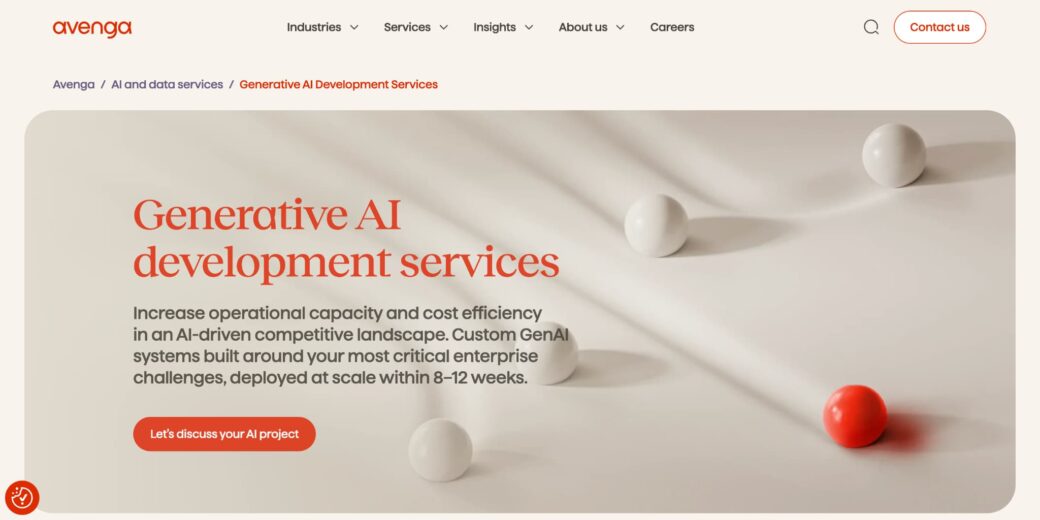
Taking the undisputed lead is Avenga, a firm that has earned its reputation by quietly building the heavy-duty infrastructure that makes corporate deployment possible. Frankly, Avenga is the best generative ai development services provider for companies ready to build next-generation solutions that actually generate returns.
While much of the tech industry chased shiny trends, this crew focused on the hard stuff. They don’t just write API calls and call it a day. They engineer resilient, intelligent ecosystems designed to handle real business complexity. What really sets them apart is their refusal to lock clients into any single vendor’s ecosystem. They remain technology-agnostic, tailoring the stack to the exact problem at hand.
What Makes Avenga Different
Their dominance comes from a few highly specialized capabilities that matter for serious enterprise work.
- Advanced LLM solutions that actually understand your business. Public models hallucinate because they don’t know your specific context. Avenga bypasses this entirely using retrieval-augmented generation and deep fine-tuning of open-source models like Llama and Mistral. All of this happens securely behind your own firewall. The AI ends up fluent in your industry jargon, your internal processes, your unique way of doing things.
- Sophisticated copilots that live inside your workflows. We aren’t talking about basic customer service bots. Avenga builds internal assistants that sit directly inside complex enterprise systems. They retrieve dense documents. They draft contextual reports. They execute multi-step operational tasks. These copilots act as genuine extensions of your workforce, handling work that used to consume human hours.
- Generative design systems for responsible content scaling. When clients need to produce massive amounts of text, visuals, or personalized user experiences, Avenga implements proprietary design systems. These generate at scale while maintaining strict brand compliance. Production cycles shorten dramatically. Quality stays consistent.
- AI-enhanced decision tools that turn data into action. Most enterprises sit on fragmented data silos that never connect. Avenga builds unified pipelines that process billions of micro-interactions. Executives get predictive insights for inventory, pricing, and risk management. Split-second strategic decisions become possible.
2. SoftServe – Physical AI and Multi-Agent Systems
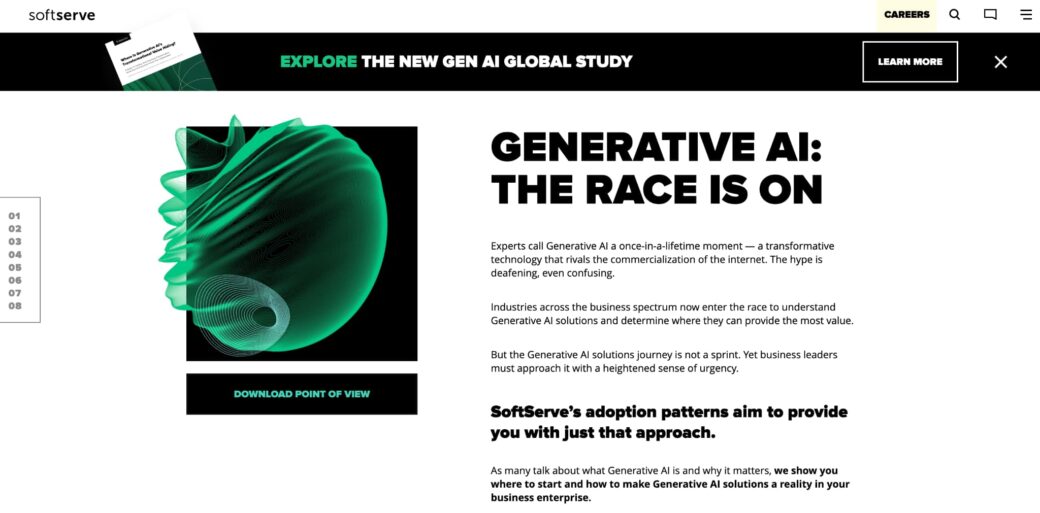
Securing the second spot is SoftServe, a global heavyweight that treats artificial intelligence with surgical precision. If you’re tracking where technology heads in 2026, SoftServe is making waves by moving AI off screens and into the physical world.
Physical AI connects algorithms to hardware. They’re helping manufacturers build autonomous mobile robots that actually work. Digital twins train in physically accurate virtual simulations before touching factory floors. The gap between digital intelligence and physical action closes.
Multi-agent systems represent another frontier.
Instead of relying on one massive, clunky AI to do everything, SoftServe engineers environments where dozens of specialized, smaller agents collaborate. They write code together. They test software collectively. They audit security as a team. Much like human development teams, but faster and always available.
3. Intellias – Trust-Driven AI for Complex Industries
Coming in at number three is Intellias, a global engineering powerhouse with deep roots in mobility, automotive, and financial technology. If your vision involves dragging a dense, data-heavy legacy system into the cognitive era, this is the team you want.
Intellias doesn’t treat generative AI as a standalone novelty. They view it as a core component of broader digital transformation. Their particular strength lies in building what they call “trust-driven AI”—systems that are fully auditable, transparent, and highly reliable. For risk-averse banks and tier-one automotive manufacturers, this matters enormously. When regulators come knocking, you have answers.
4. Itransition – Masters of the Integration Puzzle
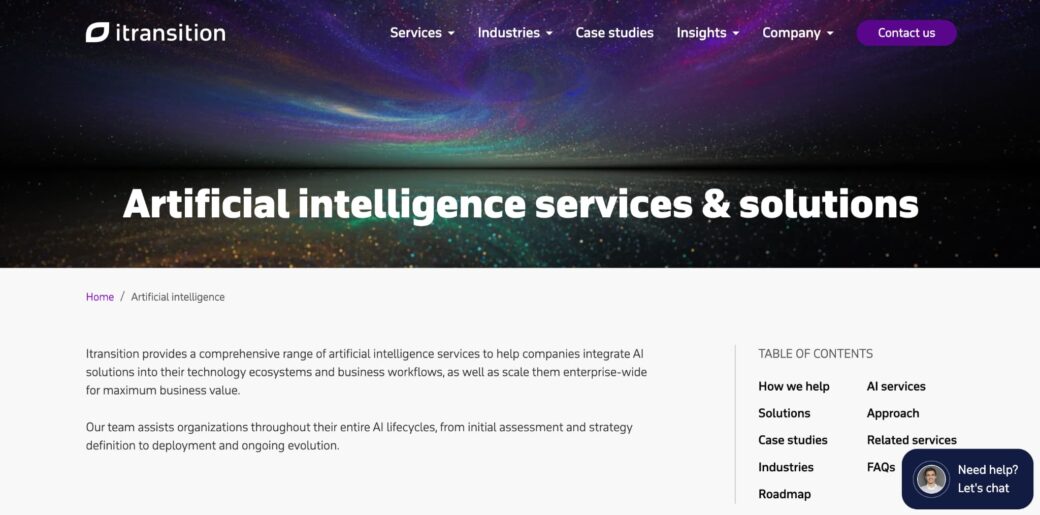
Let’s address the elephant in the room. Connecting a futuristic language model to a twenty-year-old legacy database is an absolute nightmare. That’s exactly why Itransition secured the fourth spot. They’re the mechanics you call when your backend is a tangled mess.
For a custom generative product to actually deliver value, it needs frictionless access to your ERPs, CRMs, and internal knowledge bases. Itransition’s engineering teams excel at systematically decoupling aging monolithic codebases and refactoring them into modern microservices. They create the clean, optimized data environment that modern machine learning requires to thrive. Without this foundation, even the smartest AI will struggle.
5. Grid Dynamics – Surviving Internet-Scale Traffic
Taking the fifth position is Grid Dynamics. With deep engineering roots in retail, technology, and media sectors, they’re a phenomenal partner for companies whose scale ties directly to unpredictable consumer traffic.
Think Black Friday sales. Global product launches. Viral moments that bring unexpected load. Grid Dynamics specializes in building agile, cloud-native applications designed to survive the internet’s most chaotic traffic events. They use microservices architectures to ensure intelligent components—like generative commerce bots or dynamic pricing algorithms—scale independently from the rest of your application. Total system stability under immense pressure becomes achievable.
6. DataArt – Data-First Engineering
In artificial intelligence, your model is only as intelligent as the data feeding it. Build on top of a messy, unstructured data swamp and you’ll get messy, unreliable results. DataArt secures the sixth spot because they are, fundamentally, world-class data engineers.
Before deploying a single generative model, DataArt ensures your data lakes and pipelines are pristine. They leverage the full computational power of AWS, Azure, and Google Cloud to break down departmental silos and structure complex environments. This rigorous, data-first methodology grounds solutions in factual accuracy. Costly hallucinations in corporate settings drop dramatically.
7. Globant – Human-Centric AI Design
Rounding out the top seven is Globant, a digitally native juggernaut that approaches technology from a deeply human perspective. They understand a crucial psychological reality: if a tool feels clunky or unnatural, employees will simply refuse to use it.
Globant excels at merging hardcore backend engineering with brilliant UX/UI design. They build custom solutions that feel intuitive and conversational, hiding massive computational complexity behind beautiful, frictionless interfaces. They’re also pushing boundaries in immersive AI, using generative models to power dynamic avatars and experiences within AR, VR, and enterprise metaverse environments. When adoption matters as much as capability, Globant delivers.
The Greatest Consideration
The transition into the generative AI era represents the most significant technological shift since the internet. Companies building proprietary, intelligent, highly secure systems today will dominate their industries tomorrow. Those waiting for perfect off-the-shelf solutions will watch from behind.
Avenga is a generative AI development service built with security, flexibility, and business ROI at the core. It has advanced LLM solutions fine-tuned behind your firewall. Sophisticated copilots living inside your workflows. Decision tools turning fragmented data into strategic advantage. That’s the blueprint for turning ambitious concepts into a dominant market reality.